Alex has spent more than ten years breaking down software, hardware, and new tech with clear, no-nonsense reviews and sharp industry insights. They’re the person you turn to for straightforward takes on the latest gadgets and digital tools without the usual fluff.
The Growing Role of Deception Technology in Cyber Defense
Cyberattacks aren’t just rising—they’re getting craftier and more subtle. Companies need to rethink how they detect these threats. Choosing the right deception technology vendors can make a big difference. These tools lay traps—fake files, servers, or login details—that don’t sound alarms but snare attackers cold.
Deception platforms deploy decoys that look real but are worthless to genuine users. Traditional security tools often fail against stealthy, long-term threats or insiders with access. When hackers fall for the bait, security teams get crisp, immediate alerts showing what’s going on. This shortens how long attackers roam unseen, which lessens the damage.
Not all deception vendors offer the same quality or clarity. Prices vary widely—from pay-per-use to flat-rate subscriptions—making budgeting tricky without careful planning. Some scale easily across mixed networks and cloud environments. Others focus on automation, saving security teams from drowning in false alarms.
Check how authentic and detailed the decoys appear—this is key. Startups and enterprises must match products to their own risks and systems. Vendors who disclose pricing upfront and provide hard evidence of success protect buyers from surprise costs and regulatory pitfalls (in most cases).
Deception tools pull attackers in, improving reach.
Decoys shrink hackers’ hiding time, lowering risk.
Integration with your systems and clear pricing matter most.
Real-world use cases and external reviews build trust.
Deception works as an active defense layer, supplementing firewalls and endpoint tools—not replacing them.
Investors must weigh tech strengths against transparent costs. This reveals vendors that truly upgrade security posture. Among all defenses, deception stands out because it catches intrusions live—often before damage is done.
TrapX Security – Leading Deception Technology Solutions
They spot intruders fast and cut down noisy false positives, keeping defenders a step ahead in this uneven fight. Picking and rolling out deception platforms from top vendors is a smart, forward move.
Summary: The Best top deception technology vendors
TrapX Security — Lowest subscription plans start at $500 per month for deception technology solutions
Attivo Networks — Pricing tiers start at $500 per month, making it accessible for mid-sized organizations.
Illusive Networks — Has an employee satisfaction rating of 4.4 out of 5 stars from 50 Glassdoor reviews.
Cymmetria — Offers subscription plans ranging from $500 to $2000 per month for growable deployment
Smokescreen Technologies — Subscription pricing ranges from $500 to $2000 per month, supporting various organizational scales
Guardicore — Provides paid plans starting at $500 per month suitable for varying business sizes
Lowest subscription plans start at $500 per month for deception technology solutions
TrapX Security – Leading Deception Technology Solutions
Overall4.2/5
Value4.0/5
Ease of Use4.1/5
Support4.6/5
TrapX Security starts at $500 a month. That price points to a serious promise: high-end deception technology built for deep defense. Small shops might flinch at this number. Their budgets usually don’t stretch that far. But the AI-driven system sharpens threat detection. It’s precise. What you pay matches a focus on strong protection, not cheap coverage (at least usually).
In deception tech circles, TrapX stands out with its laser-focused AI algorithms. These bots block attackers and cut down on useless alerts. That saves time and stress for security teams. Competitors like Attivo Networks don’t lay out their subscription costs clearly and mix up their features. TrapX keeps things tidy with a pricing cap at $2000 a month, giving businesses a clearer money plan.
It’s a balancing act: premium tools versus wider access. Smaller groups and startups lose a chance to give the system a test spin. So, this setup makes TrapX a choice mainly for bigger companies ready to spend serious cybersecurity cash (for the most part).
TrapX’s AI core shines by catching threats early and flagging only serious issues. This cuts alert fatigue for defenders drowning in noise. The $500 starting price fits organizations craving strong defenses while dodging distractions. But no free tier and spotty info on how it fits into existing setups make it tough for budget-tight buyers or those wrestling with complex systems to judge if it’s the right fit. TrapX seems built for full deployments, not step-by-step rollouts, pushing for a bigger upfront buy-in. Analysts back up this approach, praising the cut in false alarms. TrapX strikes a careful balance between sharp detection and hefty investment.
✓ Pros
✗ Cons
✓Lowest subscription plans start at $500 per month for deception technology solutions
✗Subscription pricing can reach up to $2000 per month, representing a major cost for some budgets
✓Employs AI-powered deception technology to delay and identify cyber attackers efficiently
✗No publicly available free plan, limiting initial access to smaller organizations
✓Offers deception capabilities designed to prevent various cyber attacks through active defense
✗Lacks explicit integration details compared to competitors in deception technology architecture
✓Implements deception methods that produce low false positive rates for early threat detection
Attivo Networks sets its prices mainly for medium-sized companies. They focus hard on spotting problems quickly without flooding users with false alerts. Smaller firms often hesitate because the upfront costs feel steep. Their deception tech uses AI to catch threats early in the attack sequence. This way, it boosts detection while keeping real assets hidden.
Attivo leans heavily on software-driven AI deception to block attackers fast after they breach. TrapX Security takes a different route. TrapX mixes hardware with software and offers clearer pricing and better integration details—stuff Attivo doesn’t fully reveal. No free trials or demo versions make it tough for cautious buyers or smaller businesses to test before buying. So, organizations with decent budgets and a plan to invest steadily in deception tech fit best with Attivo. Smaller outfits might run into a wall at the price gate.
The main strength here is Attivo’s AI deception system (give or take). If a company aims to boost layered security with sharp AI deception, Attivo presents a solid, narrowly focused, and technically deep choice—even if it demands a serious wallet. It finds attacks early while keeping false alarms low and protecting assets from compromise. Early pricing sounds reasonable to mid-sized firms but climbs quickly for bigger setups. That cost jump can scare off budget-conscious groups. Attivo’s pricing suits buyers wanting a thorough, proactive defense that slows down threats rather than just spotting them after damage. Still, the company’s limited public info on automation and integrations might complicate things for complex IT environments.
Their insights add useful context about why early threat spotting matters so much now. The FBI’s Cyber Division sheds more light on how attackers work today and how organizations should defend themselves.
✓ Pros
✗ Cons
✓Pricing tiers start at $500 per month, making it accessible for mid-sized organizations.
✗Base subscription pricing at $500 per month may be cost-prohibitive for smaller businesses.
✓Attivo’s deception solutions contribute to reducing risk without exposing real assets to attackers.
✗No free plan options explicitly mentioned for Attivo Networks, limiting trial opportunities.
✓The platform uses advanced deception techniques to identify threats with low false positive rates.
✗Pricing tiers can escalate to $2,000 per month, which might exceed budgets of many organizations.
✓Attivo Networks offers AI-powered deception technology to delay and detect cyber attackers early in the attack chain.
✗Lack of detailed information on platform-specific integrations and automation features compared to competitors.
Illusive Networks – New Deception and Threat Detection
Overall4.6/5
Value4.7/5
Ease of Use4.7/5
Support3.9/5
People who work there talk about a steady, supportive culture. Illusive Networks isn’t like other deception security companies. Their real muscle shows in how they track attackers moving through tangled enterprise setups. They don’t just drop simple honeypots; they go for sure-fire breach proofs instead of casting wide nets that catch little. Pricing stays locked down tight. No clear plans or numbers out in public. If you want costs, you’ll have to ask them yourself.
They break the usual rules on pricing and focus. Competitors like Attivo Networks do deception too, and they zip about subscriptions just as much, which can scare off buyers itching to budget. Rapid7 takes a different angle—mixing analytics with deception to catch threats broadly. Illusive zooms in on killing false alarms by sharpening deception like a scalpel. Teams who crave alerts that mean something tend to like that. So if you want neat cost sheets and ironclad service terms, Illusive might scramble you at first—trading transparency for pinpoint tools.
This plays well for mid-to-large firms with solid security foundations who want breach detection they can bank on. Fresh funding gives them fuel to upgrade their tricks: adaptive decoys, smarter traps aimed at tough threats. But they don’t share public SLAs or deployment caps. Buyers wanting clear limits before signing could hit frustration. Illusive hands you serious deception tech—but wrapped in fuzzier contract details.
Illusive Networks’ Position Among Cyber Deception Vendors
User forums paint a friendly picture, yet public analyst reviews and solid benchmarks are scarce (give or take). To play it safe, combine Illusive with other security layers, and cross-check it against trusted reports and experts aligned with your risk needs. They started up in the early 2010s and earned a rep as a go-to deception innovator. That lack might cause decision-makers to pause.
They wrestle with pricing puzzles much like Illusive does. If transparent pricing is key, glance at similar fields like cloud access security brokers and database activity monitoring. Knowing this sets realistic budget thoughts before you talk numbers. Gartner’s 2026 market definitions also offer a handy framework to size up deception tech and pick vendors that fit your security playbook perfectly.
✓ Pros
✗ Cons
✓Has an employee satisfaction rating of 4.4 out of 5 stars from 50 Glassdoor reviews.
✗Provides limited public information on specific pricing tiers or plan limits.
✓Contributed to deception-based enterprise cybersecurity products development since the 2010s.
✗No direct evidence of support SLA or response times available publicly.
✓Employs high-fidelity deception assets to validate attacker paths in cyber defense workflows.
✗Missing documented restrictions on deployment scale for hybrid infrastructures.
✓Secured recent investment for advancing deception beyond honeypots with novel approaches.
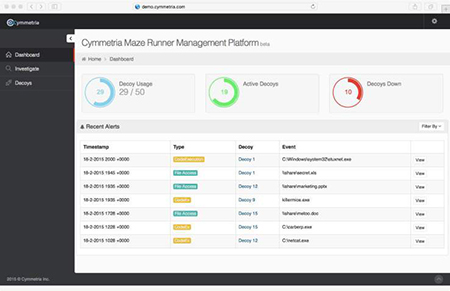
Cymmetria – Effective Deception Technology for Enterprises
Overall4.6/5
Value4.4/5
Ease of Use4.2/5
Support4.2/5
Cymmetria charges between $500 and $2000 a month. That price targets companies ready to invest seriously in advanced security (for the most part). Smaller firms might balk at those numbers or find them too rigid. This pricing is clearly meant for larger enterprises comfortable with that kind of commitment.
Compared to Illusive Networks, Cymmetria presents its pricing tiers more plainly. Costly, in fact. This reduces guesswork when planning deployment costs. Their standout feature is AI-driven deception that analyzes attacker moves to spring smarter traps. It helps detect threats faster and with sharper precision. Illusive employs a broader range of deception tactics, but Cymmetria focuses strictly on tracking attacker behavior as a defense strategy (give or take). One drawback: no free trial or low-cost entry point exists. That could prevent cash-strapped teams from trying it hands-on. Also, details on automation and integration remain scarce, which might complicate tool chaining for some firms. Overall, this solution suits mid-size to large businesses eager to be proactive.
Static decoys have become obsolete. For groups determined to snuff out threats early through behavior-based tactics, Cymmetria delivers a specialized tool — though its price and joint capabilities demand a close, thorough review. The main advantage with Cymmetria lies in its AI-powered traps that adjust continually as attackers shift tactics. Those evolving deceptions let security teams respond fast, rather than merely watch. Not surprisingly, the subscription cost matches this tech edge, excluding smaller outfits lacking budget flexibility. Cymmetria is transparent about pricing and aligns well with teams embedding active defense in broader cybersecurity strategies. Guardicore may offer broader segmentation, but it lacks Cymmetria’s AI-driven deception edge.
Quick intruder detection is key to preventing massive breaches and reducing damage. Users praise Cymmetria’s AI deception for catching attackers early.
✓ Pros
✗ Cons
✓Offers subscription plans ranging from $500 to $2000 per month for growable deployment
✗Pricing starts at $500 monthly, which may be prohibitive for small organizations
✓Integrates deception techniques to create hostile environments for cyber attackers
✗No free plan availability explicitly detailed for Cymmetria limits initial low-cost evaluation
✓Emphasizes active defense by learning from attacker behavior without risking real assets
✗Lacks documented details on specific integration or automation capabilities compared to some competitors
✓AI-powered deception technology enables early attacker identification and delays cyber attacks effectively
✗Absent clear information on support tiers or SLA response times for incident handling
Smokescreen Technologies charges between $500 and $2,000 monthly. They target mid-size to large companies prepared to invest in solid cybersecurity. Their AI-powered deception fools hackers, buying precious time and protecting real assets. This focus slashes false alarms substantially, helping security teams detect threats faster without drowning in alerts.
Unlike Attivo Networks, Smokescreen’s pricing isn’t very transparent and feels less flexible. Otherwise, cheaper or more adaptable vendors might be easier to handle. Smaller companies or those seeking affordable entry points might hesitate. Attivo emphasizes automation and smooth integration that scales well and slots into existing systems effortlessly. Smokescreen, however, doesn’t advertise comparable features. No free trials are offered; that’s a hard stop for lean budgets or security rookies. If your organization already boasts a sturdy security setup and can cover the cost, Smokescreen suits.
Smokescreen’s AI deception engine sets cunning traps that twist attacker behavior and shield critical data. This proactive defense demands a major monthly fee, designed for firms with mature ops aiming for sharper threat hunting and fewer false positives. It’s a high bar. Still, it’s not heavy on integration or workflow automation, which could trip up teams relying on deep security orchestration. If early AI-driven threat detection is your priority, Smokescreen delivers solid bite. But when flexible pricing or broad tool compatibility matters, better choices exist.
✓ Pros
✗ Cons
✓Subscription pricing ranges from $500 to $2000 per month, supporting various organizational scales
✗No free plan available, limiting initial trial or low-budget access
✓Offers AI-powered deception technology to delay and identify cyber attackers proactively
✗Base pricing at $500 per month, which may be high for small organizations
✓Includes capabilities to mislead attackers and protect real assets from compromise
✗Lacks mention of specific automation or integration features compared to some competitors
✓Enables early threat detection with low false positive rates through deception technology
Guardicore – Micro-Segmentation and Deception Security
Overall4.7/5
Value4.6/5
Ease of Use4.8/5
Support4.5/5
Guardicore’s deception platform targets mid-sized and larger companies. The platform suits groups that want solid defense paired with deeper insights. These organizations usually have enough budget to back advanced threat detection and detailed analysis tools. It slows down attackers while pulling out behavioral clues, which helps keep false alarms rare but intelligence sharp. Security teams can watch how threats behave, without risking their actual systems.
Pricing puts Guardicore ahead of rivals like Attivo Networks and Illusive Networks, but it’s not straightforward. So, the sweet spot remains mid- to large-sized teams with flexible budgets aiming to blend active defense with attacker analysis (give or take). Attivo’s costs are murky, so it’s tough to tell if you’re getting value. Illusive claims strong results yet hasn’t published hard data to prove it. Guardicore skips freebies entirely, and the top tier hits $2000 a month. That price can scare off startups and smaller companies.
Alert fatigue is a notorious drain, and Guardicore confronts it swiftly. For a close look, the 2026 Gartner report explores the nuances and evolving trends driving this technology forward. Its strongest advantage: catching intrusions early without flooding SOCs with noise. The pricing model reflects this focus, mainly serving clients who need detailed threat info and a proactive edge. Industries under heavy regulation, or those managing tangled environments, will find this approach fits neatly. Smaller teams with tight budgets might consider it out of reach. Guardicore carves a unique niche—it trades mass appeal for precise attacker tracking and delay techniques. The $2000 monthly fee may keep some emerging teams sidelined.
✓ Pros
✗ Cons
✓Provides paid plans starting at $500 per month suitable for varying business sizes
✗Higher subscription pricing tier at $2000 per month may be prohibitive for small businesses
✓Offers AI-powered deception technology to delay and identify cyber attackers effectively
✗No publicly available free plan complicates entry for limited-budget teams
✓Enables organizations to learn from attacker behavior without risking real assets
✗Pricing starting at $500 per month lacks detailed tiered feature differentiation
✓Deception tools help detect threats early with low rates of false positives
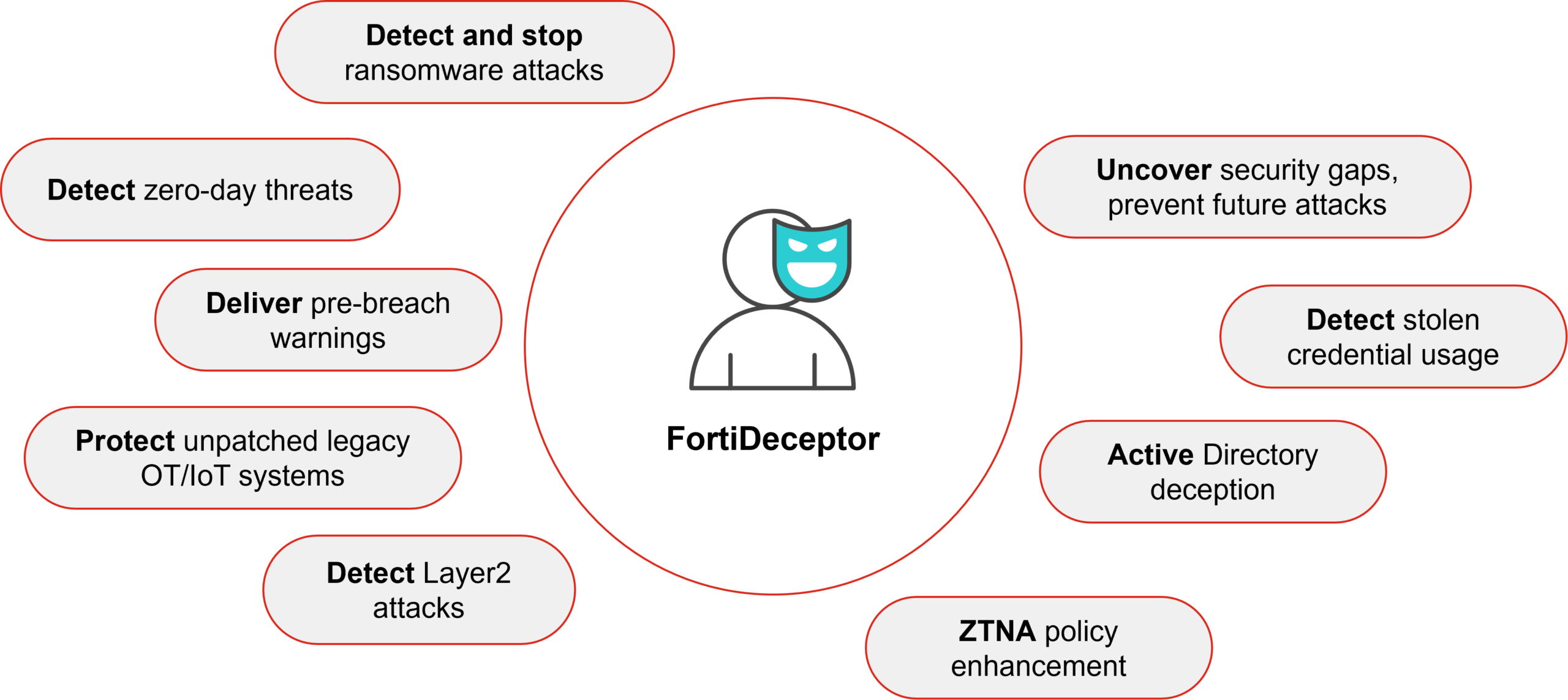
Fortinet – Complete Security with FortiDeceptor
Overall4.3/5
Value4.6/5
Ease of Use4.4/5
Support4.6/5
FortiSIEM improves incident management by uniting security tools into a single platform (broadly speaking). Fortinet’s FortiGate 200F delivers solid throughput for medium-sized environments. Together, these products let Fortinet merge perimeter defense with detailed threat analysis. This combination puts Fortinet ahead of competitors like Rapid7. Rapid7 mainly targets vulnerability management, but Fortinet builds a tighter market to reduce headaches for teams juggling multiple security products.
The cost and setup run deeper than rivals such as Attivo Networks. Smaller businesses might stumble over Fortinet’s complex licensing. FortiGate’s AppControl feature lacks the fine-tuned reach that some niche tools provide. That gap can frustrate organizations needing sharper application insights. Some midsize firms pick easier, cheaper alternatives, even though Fortinet’s FortiDeceptor leads in deception technology. FortiDeceptor excels at spotting advanced threats but suits buyers who can handle its complexity and price tag.
The true muscle behind Fortinet is the way it combines powerful firewall capabilities with advanced deception tech—all within a single platform. Yet, it carries a weight: complicated licensing structures and expensive plans that can strain smaller teams. FortiDeceptor attracts buyers aiming to catch threats preemptively—a capability not often found in this market. Still, it demands substantial investment in staff training and infrastructure, which not all groups can justify. Medium to large businesses needing broad security coverage and willing to handle these trade-offs find Fortinet a strong match. Analysts have flagged the need for clearer pricing, a point echoed by real users who praise the solid performance at scale despite ongoing complaints about licensing and application control. Fortinet Security Operations Benchmark
✓ Pros
✗ Cons
✓FortiGate 200F supports firewall throughput of up to 1 Gbps, suitable for medium-sized deployments.
✗Fortinet’s AppControl lacks the advanced capabilities found in higher-priced competitors.
✓FortiSIEM offers integrated security information and event management to simplify incident response.
✗Users have reported more complex licensing compared to alternatives, complicating mid-size client deployments.
✓Fortinet’s FortiDeceptor product leads in the cyber deception space with advanced threat detection.
✗Fortinet FortiGate’s pricing and licensing models are noted as expensive and less accessible to smaller organizations.
✓Fortinet’s products maintain consistent operational experience across their entire product line.
✗Lack of straightforward licensing led some clients to switch to competitors for easier management.
Rapid7 – Early Detection through Deception Tools
Overall4.5/5
Value4.5/5
Ease of Use4.5/5
Support4.1/5
Rapid7’s InsightVM draws a clear line for small to mid-sized teams by capping costs up to a set number of assets. But if you’re moving past mid-market size, options like Tenable—with steadier or bundled fees—can come out cheaper for large asset counts. After that, prices jump sharply. Big teams juggling many assets have to weigh full coverage against rising bills (in most cases). It runs constant, real-time scans for vulnerabilities and risks—something that often beats similar-priced rivals.
They bring together classic vulnerability management with built-in deception and broader attack surface discovery. That combo is rare in one package. InsightVM’s pricing stays simple for smaller setups, unlike the tangled subscriptions from others like Attivo Networks. Still, info on Rapid7’s deception tech fees is thin, making it harder to compare against rivals that offer clearer licensing details. The tool suits security teams planning to grow and who want combined risk reach.
But it might trip up very large organizations wanting easy per-unit fees or strong CI/CD application scanning—which InsightAppSec doesn’t fully offer yet.
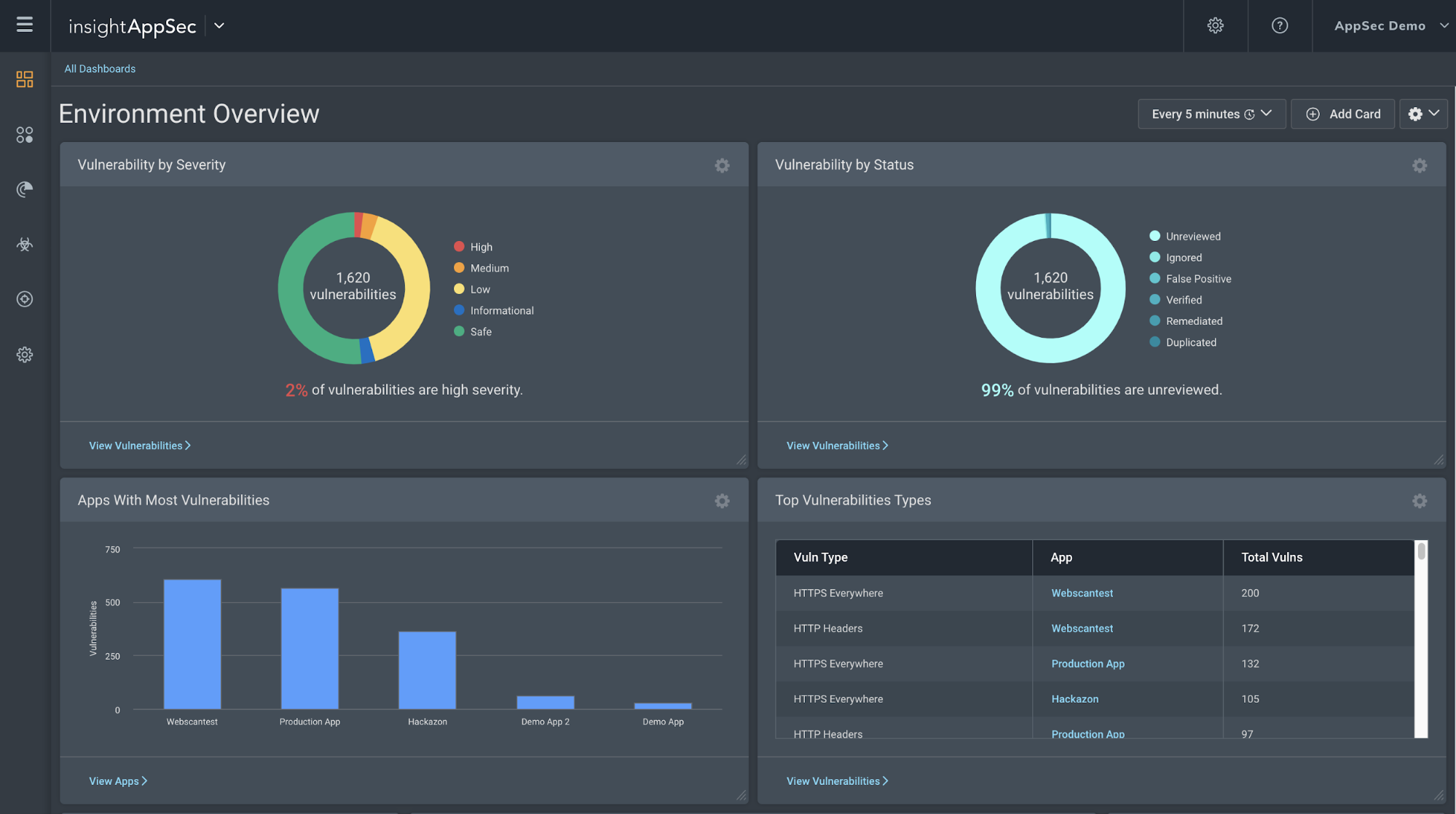
Its strength lies in nonstop asset tracking plus deception, priced for firms managing under 500 assets. This blend lets teams handle network flaws, web app bugs, and cloud misconfigs all in one sweep, ideal for broad attack surface insight. Yet it doesn’t probe deeply enough into CI/CD app security, pushing some teams toward other tools. For sprawling, complex environments, its pricing needs close attention to avoid surprises. Rapid7 nails solid exposure tracking but won’t be cheapest for massive scaling. If you want fresh independent benchmarks or updates on vulnerability management pricing, check Solid State Logic’s security reports https://www.gartner.com/en/documents/3983084.
✓ Pros
✗ Cons
✓InsightVM pricing starts at $1.93 per asset per month for up to 500 assets monitored, enabling growable cost control.
✗Volume-based pricing may increase costs for organizations with more than 500 assets, impacting budgets.
✓Rapid7 InsightVM provides continuous monitoring for real-time reach into vulnerability and risk management.
✗InsightVM pricing floors start at $1.93 per asset, possibly expensive for very large-scale asset environments.
✓Rapid7 offers deception technology tools designed to detect threats earlier in the network attack chain.
✗Some security teams report preference for CI/CD-native application security scanning not extensively supported in Rapid7 InsightAppSec.
✓Attack Surface Management capabilities in Rapid7 extend coverage to network, web apps, and cloud misconfigurations.
Pricing and Feature Differences Among Leading Vendors
Deception technology comes from several big names, each with its own price tags and feature sets. Knowing these differences helps you pick a solution that actually fits your security needs (generally).
TrapX Security leans heavily on real-time detection. Their base licenses start near $100,000 and climb as your company grows. Mostly automated, the system hunts threats while you barely need to intervene. It plugs deeply into SIEMs and endpoint tools. For broad reach into lateral movement without drowning in manual alerts, TrapX is solid. Real-time response.
The cost rises when you add traps. Attivo Networks uses a subscription model, starting around $30,000 a year for basic coverage. Its strength is flexible decoys scattered across endpoints, networks, and cloud layers that adapt dynamically. Quick to launch and offering sharp alerts, Attivo suits teams wanting fast results plus smooth IAM or EDR ties.
Illusive Networks prices by how many identities you protect, from about $75,000 per year. Organizations worried about insiders or tough APTs find it indispensable. Identity-focused deception that spots stolen credentials and lateral moves using AI-driven path analysis. It maps your attack surface thoroughly, cutting false alarms so you dive straight into real threats (at least usually).
Other vendors worth a look: Cymmetria, Guardicore, and Fortinet. Cymmetria aims at SMBs with layered deception backed by automated analysis, starting near $60,000. Guardicore fuses segmentation and deception tightly, designed for hybrid clouds and on-premises setups. Fortinet bundles deception inside a broader security lineup, pulling in customers who want firewall, endpoint, and deception from one vendor, balancing cost and convenience.
Rapid7’s InsightVM centers on vulnerability management but adds deception features as an extra boost. It suits outfits wanting risk insights and deception in one unified package.
TrapX Security fits enterprises needing growable, automated active defense.
Attivo Networks works for teams chasing quick installs, multi-layer traps, and easy operations.
Illusive Networks targets groups focusing on credential risks and identity theft.
Cymmetria offers budget-layered deception ideal for SMBs.
Guardicore serves companies with hybrid infrastructure wanting segmentation plus deception.
Fortinet draws those eyeing all-in-one security gear.
Rapid7 suits users wanting vulnerability scanning combined with deception.
Factor
TrapX Security
Attivo Networks
Illusive Networks
Cymmetria
Guardicore
Fortinet
Rapid7 InsightVM
Pricing Base
$100,000+ annual license
$30,000+ per year
$75,000+ annual license
$60,000+ base license
Contact sales
Bundled in product suite
Asset-based pricing
Deployment Focus
Automated active defense
Multi-layer decoys
Identity-centric deception
Layered deception
Hybrid infra segmentation
Integrated security fabric
Vulnerability + deception
Integration Breadth
SIEM, endpoint, network
IAM, EDR, SIEM
AI path analysis
Automated analytics
Cloud/on-premises blend
Fortinet market
Security market
Target Customer
Mid to large enterprises
Enterprises
Enterprises/Apt defenses
SMBs
Mid to large firms
Broad range clients
Mid-market to enterprises
Unique Selling Point
Real-time automated traps
Rapid deployment & alert fidelity
Credential theft focus
Cost-effective layered detection
Segment + deception combo
Single vendor convenience
Unified risk & deception
Attivo lists tier details upfront, which helps buyers quickly size up costs. That slows you, but you get a deal more custom to your needs. Not every vendor lays out prices clearly. TrapX and Illusive prefer direct talks to craft custom quotes.
If you want flexible decoys that deploy fast, Attivo leads the pack. Big teams with broad requirements tend to pick TrapX’s automated approach. Worried about insider threats or stolen creds? SMBs watching budgets might favor Cymmetria’s layered system. Guardicore shines in mixed cloud and on-prem environments. Fortinet lures those wanting firewall, endpoint, and deception all in one stack. Rapid7 appeals to those who need vulnerability and deception data side by side (as a rule).
They guide you toward a vendor matching your threat model, budget, and goals. The strengths here aren’t one-size-fits-all. No single player covers every scenario, but these contrasts cut through the marketing noise.
Deception technology creates traps—fake IT assets that look real. When attackers poke or tamper with these decoys, alerts fire off immediately. This early notice cuts down how long intruders hide and uncovers their playbook before damage piles up. Regular defenses often miss these moves, but deception grabs clues faster. Quick alerts matter.
Essential Deployment Challenges to Anticipate
You must know your network’s layout and traffic flow to plant traps where attackers roam. Too many traps flood you with false alarms, too few let threats slide. Cloud or hybrid setups make it worse—assets jump like shadows, shifting constantly. Launching and tuning these systems takes skill and steady effort to avoid alert fatigue that buries real warnings.
Integration with Existing Security Stacks
Hooking deception tech into SIEM, SOAR, and endpoint tools speeds sharing threat info and tightens your response. Automation kicks off lockdowns and close looks faster. But mixing data formats and workflows isn’t smooth; glitches cause gaps or lag. Open APIs and vendor help often grease the wheels here.
Criteria for Selecting a Deception Technology Vendor
Find solutions that grow with your setup, install cleanly, nail real alerts without noise, and cover on-prem, cloud, or hybrid equally well. Pricing needs to be upfront and flexible—subscription models can differ, and setting things up takes real hands-on time. Third-party ratings and customer reviews give clues to who actually delivers. Vendors who push updates loaded with fresh threat intel bring ongoing value.
Justifying Return on Investment for Deception Solutions
Starting costs aren’t cheap, but faster incident action and less damage usually recoup that. These tools catch sneaky breaches that slip past usual defenses and might stop costly data spills cold. Deception’s layer also helps with compliance by showing you have multiple safety nets. Think about total ownership costs alongside the security gains before you commit.
Addressing False Positives and Alert Management
Some traps ring bells from harmless scans or routine moves. Adjust sensitivity and detection details to quiet the noise. Top-tier platforms analyze alerts, rank risk levels, and add threat context. People still need to weigh in—automation helps but can’t replace sharp judgment.
Deployment Strategies for Cloud and Hybrid Networks
Cloud and hybrid setups throw curveballs—elastic workloads, containers, nonstop shifts. Vendors who offer auto-discovery and on-demand decoys ease the work here. Policies must sync across multi-cloud, SaaS, and on-prem gear to keep protection tight. This flexibility matches the fast-changing modern enterprise style.
Compliance and Privacy Considerations When Using Decoys
Decoys can’t spy on or leak sensitive user data without tripping legal alarms. Logs and alerts must stay locked down with tight access controls. Vendors compliant with GDPR and HIPAA standards cut compliance headaches in regulated industries. Audit trails prove you played by the rules during inspections.
Scalability Implications for Large Enterprises
As devices and cloud jobs balloon, running many decoys strains resources. Smart vendors offer orchestration tools and dashboards to automate updates, patching, and tracking performance on a grand scale. Flexible licensing that matches asset counts saves money when environments get sprawling.
The Evolving Role of AI and Automation in Deception
Today’s deception platforms use machine learning to split real attacks from background noise and pivot as new tricks appear. Automation speeds reactions and eases analyst burnout. Vendors who bake AI analytics into their tech ramp up detection accuracy while lowering false alarms. This shift pushes deception to become smarter and a must-have in layered defense.
Deception tech’s setup and tuning are tricky. That shouldn’t scare teams wanting stronger security. Picking the right vendor and planning the rollout carefully transforms deception into a sharp tool that spots threats clearly and fits with your existing gear. If you’re deciding, deep reviews and test results nail down which options match your risk appetite and resources. Also, check our detailed guides on Cloud Access Security Broker Solutions and Single Sign On Solutions for Small Business—both link closely to smooth cloud security and integration.
Deception is still niche, but it’s charging ahead by moving defenders from scrambling to striking first—exactly what today’s speeding threat world demands. Sources like Gartner’s market guide back tech claims and vendor strength with fresh analyst ratings and future looks.








 TrapX Security – Leading Deception Technology Solutions
 Attivo Networks – Advanced Cyber Deception Platform

 Cymmetria – Effective Deception Technology for Enterprises